by Don Norman
Table of Contents
- Chapter 1: The Psychopathology of Everyday Things
- Chapter 2: The Psychology of Everyday Actions
- Chapter 3: Knowledge in the Head and in the World
- Chapter 4: Knowing What to Do: Constraints, Discoverability, and Feedback
- Chapter 5: Human Error? No, Bad Design
- Chapter 6: Design Thinking
- Chapter 7: Design In the World of Business
Chapter 1: The Psychopathology of Everyday Things
Summary
-
Good design must have good discoverability and understanding. Discoverability means it must be possible to figure out which actions are possible and how to perform those actions. Understanding refers to how these products are supposed to be used, and what do the different actions mean
-
Good design requires good understanding of human-machine interaction. Often times, design are done by experts who have limited understanding of their target users. Humans are amazingly complex, and we need to learn to understand human behaviour the way it is, not the way we would wish it to be
-
Good design requires understanding of human psychology and behaviour. Good design also requires good communication. We need to communicate what actions are possible. It is also important to communicate what is happening, and what is about to happen. This is especially important when things go wrong
-
There are 7 fundamental principles design principles: discovery, affordances, signifiers, mapping, feedback, conceptual models, constraint
- Discovery determines what actions are possible and the current state of the device
- Affordances determine which actions are possible. It can intuitively tells you how an object should be used. For example, a flat horizontal surface of a chair affords sitting. The looped handle of a coffee mug affords grasping, while the hollow cavity affords holding liquid
- Signifiers are any mark, sound, hint, or any perceivable cues that communicates appropriate behaviour to a person (any perceivable cue that communicates meaning). Meaning refers to information about the state of the world, and the appropriate behaviour. For example, the sign PUSH on a door signifies that the door should be pushed at the flat plate beneath the sign
- Mapping is the relationship between controls and their effects. An example is a steering wheel. If we turn it to the right the car goes right. Another example is a volume slider. If we move the slider up, the volume increases
- Feedback communicates the result of an action. Feedback must be immediate, and must be informative. More feedback is not always better
- Conceptual models are explanations in someone’s mind of how something works. It is like an underlying mental representation. For example, the files and folders on computers. There are no real folders inside the machine; it is just a metaphor that gives us a workable conceptual model for organizing data
- Constraint is the physical, logical, semantic, and cultural constraints that guide actions and ease interpretation
Chapter 1 Highlights
Two of the most important characteristics of good design are discoverability and understanding. Discoverability: Is it possible to even figure out what actions are possible and where and how to perform them? Understanding: What does it all mean? How is the product supposed to be used? What do all the different controls and setting means?
When [designs are done] badly, the products are unusable, leading to great frustration and irritation. Or they might be usable, but force us to behave the way the product wishes rather than as we wish.
But most of the [deficiencies in human-machine interaction] come from a complete lack of understanding of the design principles necessary for effective human-machine interaction. Because much of the design is done by engineers who are experts in technology but limited in their understanding of people.
The solution is human-centered design (HCD), an approach that puts human needs, capabilities, and behaviour first, then designs to accommodate those needs, capabilities, and ways of behaving good design starts with an understanding of psychology and technology. Good design requires good communication, especially from machine to person, indicating what actions are possible, what is happening, and what is about to happen.
Designers need to focus their attention on the cases where things go wrong, not just on when things work as planned.
Designers need to focus their attention on the cases where things go wrong, not just on when things work as planned.
Affordances exist even if they are not visible. For designers, their visibility is critical: visible affordances provide strong clues to the operations of things. A flat plate mounted on a door affords pushing. Knobs afford turning, pushing, and pulling. Slots are for inserting things into. Balls are for throwing or bounding. Perceived affordances help people figure out what actions are possible without the need for labels or instructions.
The term signifier refers to any mark or sound, any perceivable indicator that communicates appropriate behaviour to a person. Signifiers can be deliberate and intentional, such as the sign PUSH on a door, but they may also be accidental and unintentional, such as our use of the visible trail made by previous people walking through a field or over a snow-covered terrain to determine the best path. Or how we might use the presence or absence of people waiting at a train station to determine whether we have missed the train. The signifier is an important communication device to the recipient, whether or not communication was intended It doesn’t matter whether the useful signal was deliberately placed or whether it is incidental: there is no necessary distinction.
(On mapping) It doesn’t matter whether these conceptual models are accurate: what matters is that they provide a clear way of remembering and understanding the mappings
Feedback must be immediate: even a delay of a tenth of a second can be disconcerting. If the delay is too long, people often give up, going off to do other activities. This is annoying to the people, but it can also be wasteful of resources when the system spends considerable time and effort to satisfy the request, only to find that the intended recipient is no longer there. Feedback must also be informative. Many companies try to save money by using inexpensive lights or sound generators for feedback. These simple light flashes or beeps are usually more annoying than useful. They tell us that something has happened, but convey very little information about what has happened, and then nothing about what we should do about it.
Too many [feedback] cause people to ignore all of them, or wherever possible, disable all of them, which means that critical and important ones are apt to be missed.
Simplified models are valuable only as long as the assumptions that support them hold true.
Mental models, as the name implies, are the conceptual models in people’s minds that represent their understanding of how things work. Different people may hold different mental models of the same item.
Conceptual models are valuable in providing understanding, in predicting how things will behave, and in figuring out what to do when things do not go as planned. A good conceptual model allow us to predict the effects of our actions. Without a good model, we operate by rote, blindly; we do operations as we were told to do them; we can’t fully appreciate why, what effects to expect, or what to do if things go wrong.
Chapter 2: The Psychology of Everyday Actions
High-level Overview
The focus is on what is going on in a person’s head when they act.
Summary
-
The Seven Stages of Action is the core framework. Any action is broken down into 7 steps: forming goal, then on the “execution” side — plan, specify, perform — and on the “evaluation” side — perceive, interpret, compare the result against the goal. It’s a loop, so we act and then evaluate.
-
High-level goals could be decomposed into subgoals that cycle through the 7 stages multiple times. They key insight is that goals cascade through multiple levels. Each high-level goal breaks down into subgoals, and each runs through its own action cycle. The goal someone state upfront is rarely the actual underlying goal. By asking why repeatedly (doing root cause analysis) we uncover the fundamental need beneath the surface request. Good design means addressing that root goal, not just the stated one.
-
The 2 Gulfs is the payoff of the 7 stages. The Gulf of Execution is the gap between what you want to do and figuring out how (how do I operate this?). The Gulf of Evaluation is the gap in understanding what happened (did it work?). Good design bridges both. Signifiers, constraints, mapping, and good conceptual models help bridge execution, feedback and good conceptual models help bridge evaluation.
-
Three Levels of Processing is a model of the mind: visceral (fast, automatic, gut reaction), behavioural (learned, routine skills, most everyday action lives here), and reflective (slow, conscious reasoning).
Chapter 2 Highlights
What about radical ideas, ones that introduce new product categories to the marketplace? These come about by reconsidering the goals, and always asking what the real goal is: what is called the root cause analysis. Harvard Business School marketing professor Theodore Levitt once pointed out, “People don’t want to buy a quarter-inch drill. They want a quarter-inch hole!” Levitt’s example of the drill implying that the goal is really a hole is only partially correct, however. When people go to a store to buy a drill, that is not their real goal. But why would anyone want a quarter-inch hole? Clearly that is an intermediate goal. Perhaps they wanted to hang shelves on the wall. Levitt stopped too soon. Once you realize that they don’t really want the drill, you realize that perhaps they don’t really want the hole, either: they want to install their bookshelves. Why not develop methods that don’t require holes? Or perhaps books that don’t require bookshelves
Emotion is highly underrated. In fact, the emotional system is a powerful information processing system that works in tandem with cognition. Cognition attempts to make sense of the world: emotion assigns value. It is the emotional system that determines whether a situation is safe or threatening, whether something that is happening is good or bad, desirable or not. Cognition provides understanding: emotion provides value judgments. A human without a working emotional system has difficulty making choices. A human without a cognitive system is dysfunctional.
People are innately disposed to look for causes of events, to form explanations and stories. That is one reason storytelling is such a persuasive medium. Stories resonate with our experiences and provide examples of new instances. From our experiences and the stories of others we tend to form generalizations about the way people behave and things work. We attribute causes to events, and as long as these cause-and-effect pairings make sense, we accept them and use them for understanding future events. Yet these causal attributions “are often erroneous. Sometimes they implicate the wrong causes, and for some things that happen, there is no single cause; rather, a complex chain of events that all contribute to the result: if any one of the events would not have occurred, the result would be different. But even when there is no single causal act, that doesn’t stop people from assigning one
- Do not blame people when they fail to use your products properly.
- Take people’s difficulties as signifiers of where the product can be improved.
- Make it possible to correct problems directly from help and guidance messages. Allow people to continue with their task: Don’t impede progress—help make it smooth and continuous. Never make people start over
- Assume that what people have done is partially correct, so if it is inappropriate, provide the guidance that allows them to correct the problem and be on their way
- Think positively, for yourself and for the people you interact with.
Chapter 3: Knowledge in the Head and in the World
High-level Overview
The main idea is the knowledge needed to behave correctly is split between our head and the world. We can lean on the world so we don’t have to memorize everything. Good design exploits that by pushing knowledge into the world (through cues, mappings, constraints, and conventions) to lighten the mental load, while still respecting how memory actually works.
Summary
-
Accurate behaviour doesn’t require accurate knowledge in the head, because a lot of the knowledge we need is sitting out in the world (labels, layouts, cues, constraints). For example, most people can’t accurately draw a coin from memory, yet they use coins perfectly well every day. We offload knowledge to the environment. Knowledge in the world is easy to use and self-reminding but requires cues to be present; knowledge in the head is fast and works anywhere but takes learning and effort to acquire.
-
Putting knowledge in the world through physical constraints, natural mappings, and shared cultural conventions reduces what we have to remember and prevents errors. Conventions are knowledge in the world that a whole culture agrees on.
- Examples:
- Physical constraint: a SIM card or USB-A plug that only physically fits one way. The world prevents the wrong action; you don’t have to remember the orientation
- Natural mapping: drag-to-move text on smartphones
- Cultural convention: red means stop, a hamburger icon (☰) means “menu,” scrolling down moves you further into a page.
- Examples:
Chapter 3 Highlights
Some things can only be solved by massive cultural changes, which probably means they will never be solved.
To maximize efficiency of working memory (STM) it is best to present different information over different modalities: sight, sound, touch (haptics), hearing, spatial location, and gestures.
Rote learning creates problems. First, because what is being learned is arbitrary, the learning is difficult: it can take considerable time and effort. Second, when a problem arises, the memorized sequence of actions gives no hint of what has gone wrong, no suggestion of what might be done to fix the problem. Although some things are appropriate to learn by rote, most are not.
Conceptual models are powerful explanatory devices, useful in a variety of circumstances. They do not have to be accurate as long as they lead to the correct behavior in the desired situation.
Chapter 4: Knowing What to Do: Constraints, Discoverability, and Feedback
High-level Overview
When we face with something new with no instructions, we can mostly figure it out through constraints working together with affordances, signifiers, mapping, and feedback. Constraints narrow the options; the others make actions possible, visible, and confirmable.
Summary
-
There are 4 kinds of constraints:
-
Physical — the shape of things limits what’s possible e.g. a USB plug or key that only fits one way
-
Cultural — learned social conventions and scripts e.g. how you would behave in a restaurant
-
Semantic — the meaning of the situation dictates the action e.g. a windshield must face the rider, so it can only go on one way to make sense
-
Logical — reasoning fills the gap e.g. if one piece and one spot are left, they must go together
-
-
Forcing functions is a special, stronger class of physical constraints
- Interlocks force actions into the right sequence (a microwave won’t run with the door open)
- Lock-ins keep something going so you can’t stop prematurely (e.g. “Are you sure you want to quit without saving?” dialog)
- Lockouts prevent from entering a dangerous place e.g. stairwell barriers at the ground floor so you don’t flee into basement during a fire
-
Standardization can be used as the desperate last resort when affordances, signifiers, mapping, and constraints can’t make something intuitively discoverable. We can standardize so people only have to learn it once and that knowledge transfers everywhere. This is something good design try to avoid, that’s why it is deemed desperate.
-
Skeuomorphic design is when new technologies retain the look or features of the older familiar things they replaced e.g. digital notepad app styled to look like a yellow legal pad, carrying over old conventions to make the unfamiliar feel familiar, even when those features no longer serve any functional purpose.
Chapter 4 Highlights
Constraints are powerful clues, limiting the set of possible actions. The thoughtful use of constraints in design lets people readily determine the proper course of action, even in a novel situation.
A usable design starts with careful observations of how the tasks being supported are actually performed, followed by a design process that results in a good fit to the actual ways the tasks get performed. The technical name for this method is task analysis. The name for the entire process is human-centered design (HCD)
Real, natural sound is as essential as visual information because sound tells us about things we can’t see, and it does so while our eyes are occupied elsewhere. The absence of sound can mean an absence of knowledge, and if feedback from an action is expected to come from sound, silence can lead to problems.
“Standardization is indeed the fundamental principle of desperation: when no other solution appears possible, simply design everything the same way, so people only have to learn once. If you can’t put the knowledge on the device (that is, knowledge in the world), then develop a cultural constraint: standardize what has to be kept in the head. […] The standards should reflect the psychological conceptual models, not the physical mechanics. […] Standards simplify life for everyone. At the same time, they tend to hinder future development. Nonetheless, when all else fails, standards are the way to proceed
Skeuomorphic is the technical term for incorporating old, familiar ideas into new technologies, even though they no longer play a functional role. Skeuomorphic designs are often comfortable for traditionalists, and indeed the history of technology shows that new technologies and materials often slavishly imitate the old for no apparent reason except that is what people know how to do. […] It has its benefits in easing the transition from the old to the new. It gives comfort and makes learning easier. […] Eventually, new forms emerge that have no relationship to the old, but the skeuomorphic designs probably helped the transition.
Chapter 5: Human Error? No, Bad Design
High-level Overview
Human error is normal and usually a symptom of bad design, so rather than blaming people, we should design systems that prevent slips and mistakes where possible and catch, tolerate, and reverse the ones that still happen.
Summary
-
Most “human error” is really bad design, because systems are built for how designers wish people behaved rather than how people actually behave.
-
We should treat error as a normal, expected part of human activity and design to prevent, tolerate, and recover from it rather than blaming and punishing the person.
-
There are 2 fundamental types of errors: slips and mistakes. The difference comes down to whether our goal was right
-
Slip is when we have the right intention but the execution goes wrong. Slips typically happen during skilled, automatic behavior when we are not consciously thinking (e.g. pouring orange juice into your coffee)
-
Slips include capture slips (a more familiar, well-practiced action hijacks the one we intended), description-similarity slips (we act on the wrong object because it resembles the right one), memory-lapse slips (we forget a step, like leaving a card in the ATM), and mode errors (the device is in a different mode than assume)
-
A mistake is when the goal or plan itself is wrong we form the wrong intention in the first place, so even flawless execution leads to the wrong outcome, and mistakes come from higher-level conscious thinking.
-
The main kinds of mistakes include rule-based mistakes (read the situation correctly but apply the wrong rule), knowledge-based mistakes (act on incomplete or incorrect knowledge, common in unfamiliar situations), and memory-lapse mistakes (forget a goal or step in the plan).
-
Slips are generally easier to detect than mistakes, because with a mistake our faulty understanding makes the wrong action feel correct, so nothing alerts us.
-
-
Social and institutional pressures could be causes of error, since time pressure, fatigue, interruptions, and “get the job done” culture push people into unsafe shortcuts and even deliberate violations.
-
Swiss cheese model could be used to explain how errors lead to accidents, where multiple layers of defense each have holes, and a serious accident only happens when the holes happen to line up, so good systems add more layers and shrink the holes.
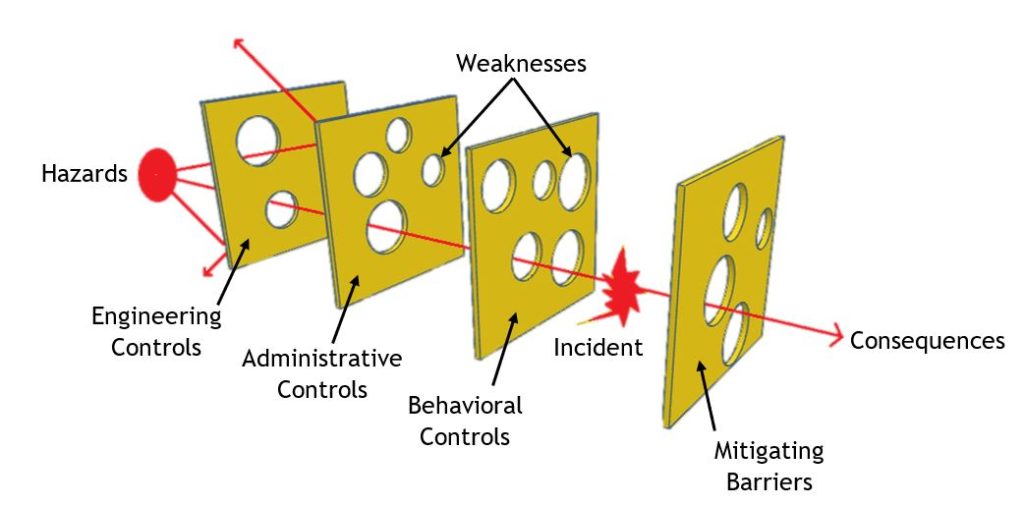
- A key institutional lesson is that errors must be reportable without punishment (as in aviation’s confidential reporting systems), because blaming and punishing people just hides errors instead of fixing their root causes.
- The practical design lessons are to add sensible constraints and forcing functions to block errors, make actions reversible (undo) so errors are cheap, build in confirmations and sanity checks, and use good feedback so errors are easy to catch and correct.
- The overall takeaway is a shift in mindset: when something goes wrong, the right response is to ask what about the design allowed the error, not to ask what’s wrong with the person.
Chapter 5 Highlights
Never underestimate the power of social pressures on behavior, causing otherwise sensible people to do things they know are wrong and possibly dangerous.
We need to reward safety and put it above economic pressures. It helps if the equipment can make the potential dangers visible and explicit, but this is not always possible. To adequately address social, economic, and cultural pressures and to improve upon company policies are the hardest parts of ensuring safe operation and behavior.
To err is human: we all are subject to slips and mistakes when under stress, or under time or social pressure, or after being subjected to multiple interruptions, each essential in its own right. It is not a threat to professional competence to be human.
The absence of something that should have been done is always more difficult to detect than the presence of something that should not have been done.
Don’t treat the action as an error; rather, try to help the person complete the action properly. Think of the action as an approximation to what is desired.
The request for confirmation seems like an irritant rather than an essential safety check because the person tends to focus upon the action rather than the object that is being acted upon. A better check would be a prominent display of both the action to be taken and the object, perhaps with the choice of “cancel” or “do it.” The important point is making salient what the implications of the action are
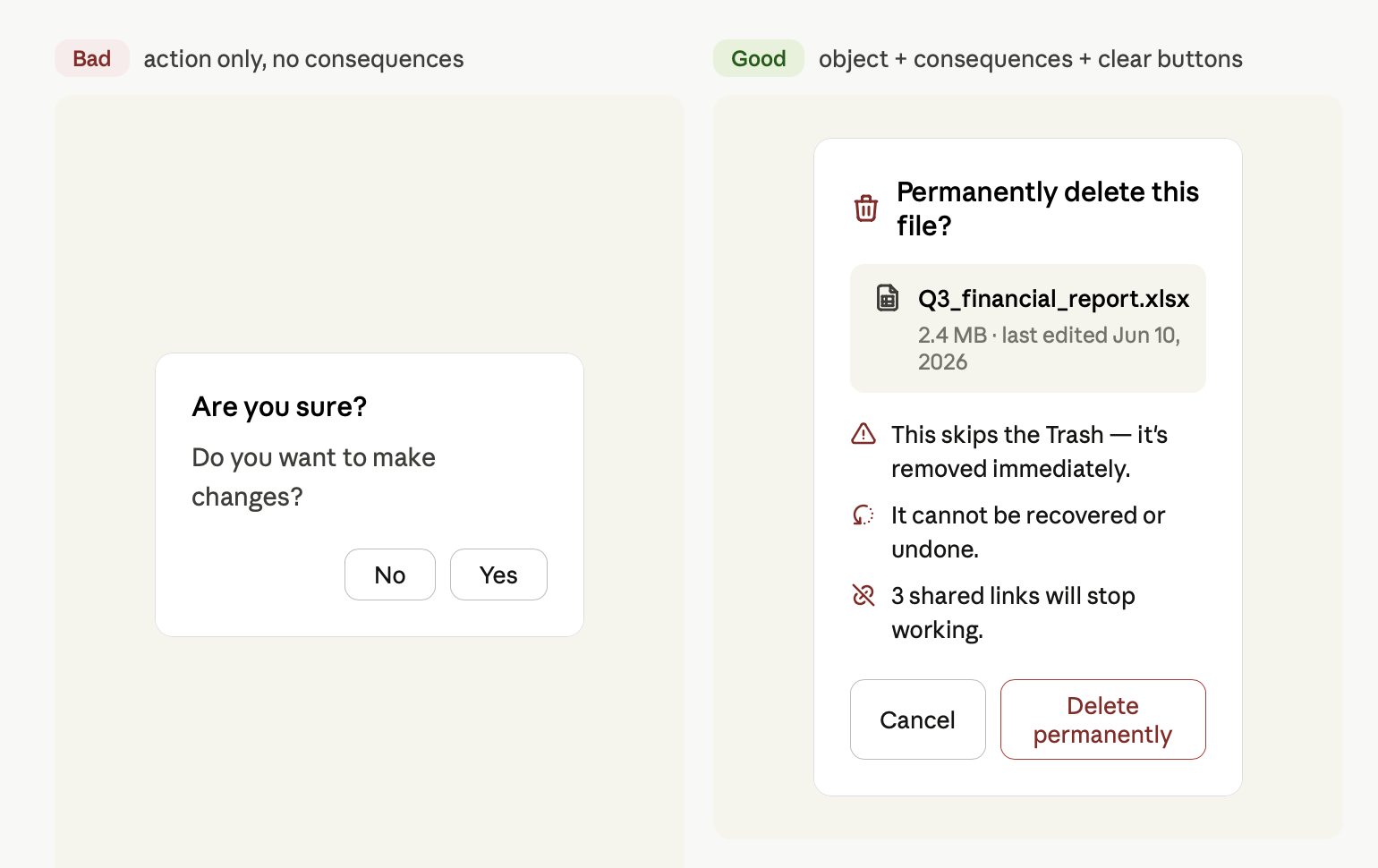
Warning messages are surprisingly ineffective against mistakes.
Accidents often have numerous contributing causes, no single one of which is the root cause of the incident.
Accidents usually have multiple causes, whereby had any single one of those causes not happened, the accident would not have occurred.
It is relatively easy to find some action or decision that, had it been different, would have prevented the accident. But that does not mean that this was the cause of the accident. It is only one of the many causes: all the items have to line up. You can see this in most accidents by the “if only” statements. “If only I hadn’t decided to take a shortcut, I wouldn’t have had the accident.” “If only it hadn’t been raining, my brakes would have worked.” “If only I had looked to the left, I would have seen the car sooner.” Yes, all those statements are true, but none of them is “the” cause of the accident. Usually, there is no single cause.
The Swiss cheese metaphor suggests several ways to reduce accidents:
- Add more slices of cheese.
- Reduce the number of holes (or make the existing holes smaller).
- Alert the human operators when several holes have lined up.
What we call “human error” is often simply a human action that is inappropriate for the needs of technology. As a result, it flags a deficit in our technology. It should not be thought of as error. We should eliminate the concept of error: instead, we should realize that people can use assistance in translating their goals and plans into the appropriate form for technology
Put the knowledge required to operate the technology in the world. Don’t require that all the knowledge must be in the head. Allow for efficient operation when people have learned all the requirements, when they are experts who can perform without the knowledge in the world, but make it possible for non-experts to use the knowledge in the world. This will also help experts who need to perform a rare, infrequently performed operation or return to the technology after a prolonged absence
Chapter 6: Design Thinking
High-level Overview
Design is an iterative, human-centered process. We find the real problem, then repeatedly prototype and test solutions for how people actually behave. But in practice, this ideal is constrained by business realities (cost, schedule, competition, featuritis), so real design is always a balancing act among many competing requirements.
Summary
-
The foundational idea is that designers must not accept the stated problem at face value but first dig to find the real problem, because people (and clients) usually describe symptoms rather than root causes.
-
The double-diamond model of design is used to find the right problem to solve and find the right solution to the problem. First diverge to explore widely and then converge to define. This is done twice: once to find the right problem, and once to find the right solution.
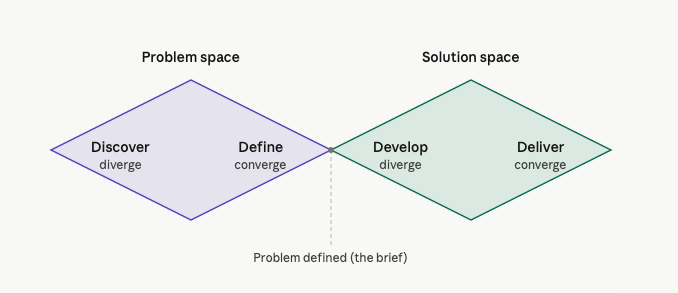
-
Human-Centered Design (HCD) process is an iterative loop of four activities: observation, idea generation, prototyping, and testing.
-
Observation means studying real people in their natural context to uncover their actual needs (this is “design research”), because what people say they do often differs from what they actually do.
-
Idea generation (ideation) means producing many ideas without early criticism, questioning assumptions and avoiding fixating on the first solution that comes to mind.
-
Prototyping means building quick, cheap, rough versions (sketches, mockups) so ideas can be tested before expensive commitment.
-
Testing means putting prototypes in front of real users, observing where they struggle, and feeding that back into the next iteration — and the whole four-step loop repeats, spiraling toward a better design.
-
-
Design research is different from market research. Design research figures out what to build (true needs). Market research figures out whether it will sell. Both matter, but they answer different questions.
-
A product is behind schedule and over budget the day development begins, because schedule pressure, limited resources, and many competing stakeholders constantly force trade-offs.
Chapter 6 Highlights
One of my rules in consulting is simple: never solve the problem I am asked to solve. Why such a counterintuitive rule? Because, invariably, the problem I am asked to solve is not the real, fundamental, root problem. It is usually a symptom
How do you know you solved the correct problem?” They are puzzled. Engineers and business people are trained to solve problems. Why would anyone ever give them the wrong problem? “Where do you think the problems come from?” I ask. The real world is not like the university. In the university, professors make up artificial problems. In the real world, the problems do not come in nice, neat packages. They have to be discovered. It is all too easy to see only the surface problems and never dig deeper to address the real issues.
Good designers never start by trying to solve the problem given to them: they start by trying to understand what the real issues are.
Human-centered design (HCD) is the process of ensuring that people’s needs are met, that the resulting product is understandable and usable, that it
Question everything. I am particularly fond of “stupid” questions. A stupid question asks about things so fundamental that everyone assumes the answer is obvious. But when the question is taken seriously, it often turns out to be profound: the obvious often is not obvious at all. What we assume to be obvious is simply the way things have always been done, but now that it is questioned, we don’t actually know the reasons. Quite often the solution to problems is discovered through stupid questions, through questioning the obvious.
Requirements made in the abstract are invariably wrong. Requirements produced by asking people what they need are invariably wrong. Requirements are developed by watching people in their natural environment.
Activities are hierarchical, so a high-level activity (going to work) will have under it numerous lower-level ones. In turn, low-level activities spawn “tasks,” and tasks are eventually executed by basic “operations” (so we should design for activities because designing for a task is too restrictive)
Producing a good product requires a lot more than good technical skills: it requires a harmonious, smoothly functioning, cooperative and respectful organization.
Designing for people with special needs is often called inclusive or universal design. Those names are fitting, for it is often the case that everyone benefits. Make the lettering larger, with high-contrast type, and everyone can read it better. In dim light, even the people with the world’s best eyesight will benefit from such lettering. Make things adjustable, and you will find that more people can use it, and even people who liked it before may now like it better
The most important principle for taming complexity is to provide a good conceptual model
Chapter 7: Design In the World of Business
Summary
-
Design never happens in a vacuum but is constantly shaped by business realities — cost, competition, marketing, and the demands of the marketplace.
-
Featuritis is a result of “feature wars” where rival products drive companies to keep piling on features that each look justified but collectively bloat the product.
-
New technologies force change but adoption is slow, because technology evolves quickly while human behavior, habits, and culture change very slowly.
-
There are two forms of innovation: incremental and radical, where incremental innovation is the small, continuous improvement of existing products (by far the most common kind), and radical innovation starts fresh and changes paradigms. Most successful innovation is incremental, because radical innovation is rare, extremely risky, and fails far more often than it succeeds, even though the rare success can transform everything.
-
Technology will keep changing but the fundamental principles — affordances, signifiers, mapping, feedback, conceptual models, and human-centered design, remain constant. We should strive for better, more humane design.
Chapter 7 Highlights
Most companies compare features with their competition to determine where they are weak, so they can strengthen those areas. Wrong, argues Moon. A better strategy is to concentrate on areas where they are stronger and to strengthen them even more. Then focus all marketing and advertisements to point out the strong points. This causes the product to stand out from the mindless herd
The lesson is simple: don’t follow blindly; focus on strengths, not weaknesses. “If the product has real strengths, it can afford to just be “good enough” in the other areas.
What industries are ready for radical innovation? Try education, transportation, medicine, and housing, all of which are overdue for major transformation.
The key to winning the race is not to compete against machines but to compete with machines. Fortunately, humans are strongest exactly where computers are weak, creating a potentially beautiful partnership.